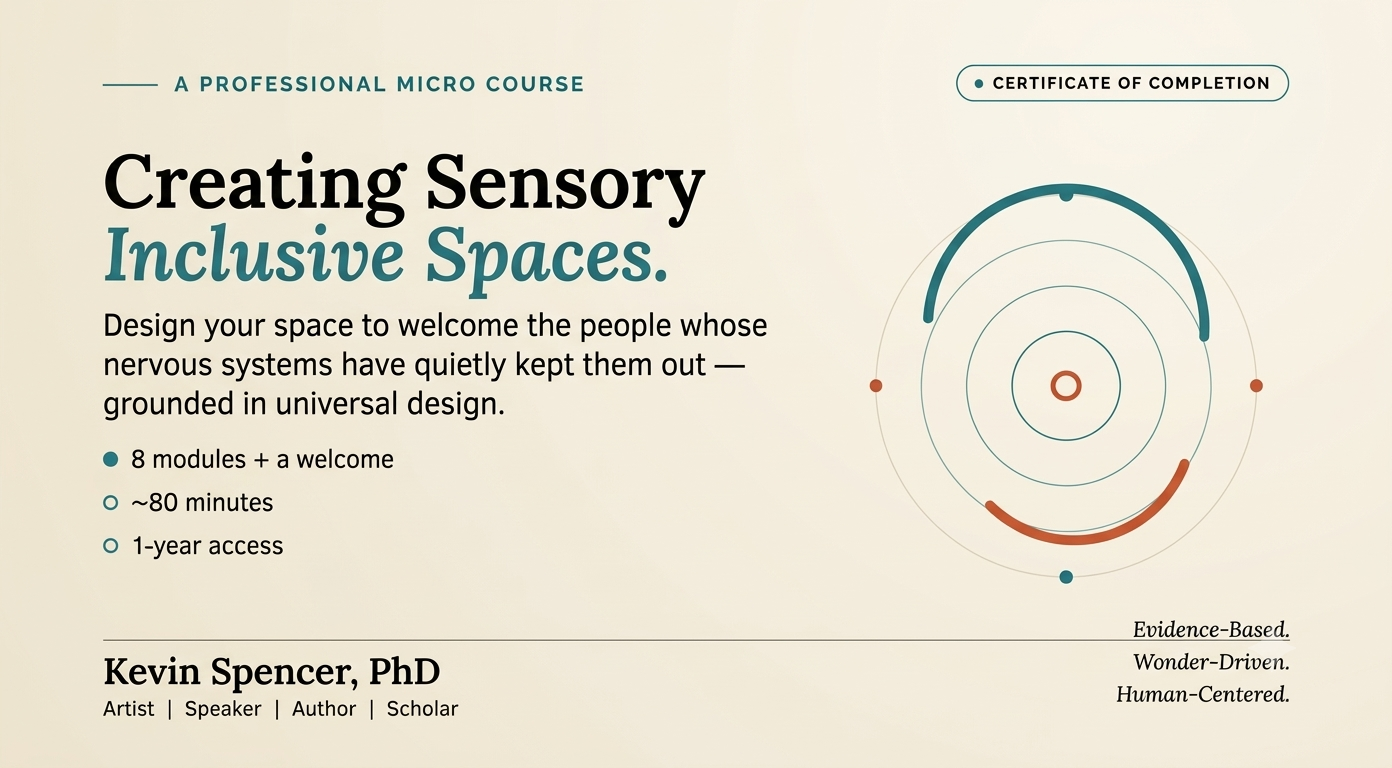
Practical, universal-design approaches for welcoming more people into the places where we gather Eight modules with changes you can start making to your space this week
Built from two decades of work in theaters, museums, schools, libraries, and places of worship.
$5
Enroll Course - Buy NowOne-time payment - 1 Year access.
 Duration 80 Minutes
 Modules 8 Modules
 Language English
 Includes 1 Course
 Access Duration 1 Year
-
Modules
8 Modules
-
Level
Beginner/Intermediate
-
Last Update
27 Sep, 2026
Who I Built This For
I built this course for the theater and arts leader who has watched a family slip out at intermission and wondered what might have kept them in their seats, and who wants the main experience to work for more people without giving up what makes the work special.
I built it for the educator who sees how quickly the noise, lights, and crowding of a busy classroom, gym, or assembly can pull a student out of learning, and who wants to design a room where more children can stay engaged.
I built it for museum, library, and community center staff who plan exhibits, programs, and events and want every visitor to feel the space was designed with them in mind.
I built it for the worship leader and congregation volunteers who want whole families to be able to worship together, including the ones who have quietly stopped coming.
I built it for the operations and facilities teams, the front-of-house staff, the ushers, greeters, and volunteers at the door, the people who shape a visitor’s experience before the program even begins.
If you are responsible for a room where people gather, this course is for you. No specialized background is required.
What You’ll Learn
Creating Sensory Inclusive Spaces is a design and operations course. My other courses help educators, therapists, and caregivers understand the people they serve, and this one turns to the spaces themselves. It gives you a practical framework for reshaping your environment, your programming, and your policies so that people whose nervous systems have kept them away can finally walk in and stay.
By the end of this course, you’ll be able to:
✓ Recognize the audience you are missing and understand why they have stopped coming
✓ Design for nervous systems instead of diagnoses, with a working understanding of how sensory sensitivity affects people from autism to PTSD to dementia
✓ Explain the difference between a separate sensory-friendly event and a sensory-inclusive experience built into your regular programming
✓ Apply universal design, the principle behind the curb cut, to your lighting, sound, layout, and pacing
✓ Walk your space the way a visitor experiences it, through arrival, pre-show, the program itself, and the retreat
✓ Review any performance, lesson, service, or program using three practical questions
✓ Understand what families, caregivers, and participants say a welcoming experience means to them
✓ Build a realistic roadmap for this week, this quarter, and this year, with the right people and partners involved
What’s Inside
A short welcome followed by eight modules that move from understanding to action. The modules are designed to be taken in order, and each one closes with a one-minute reflection. Most learners complete the course in about 80 minutes.
Welcome & Introduction
The Shape of the Course
How the course unfolds, what you will leave with, and one person from your own community to keep in mind as you work through each module.
Module 1: The Invitation
Why Sensory Inclusion Matters
The audience that never sends feedback, who sensory inclusion serves, and why this work is best understood as good design instead of charity.
Module 2: Who We’re Designing For
Sensory Sensitivities Across Populations
The three clusters and seven populations affected by sensory sensitivity, the size of the audience involved, and what an overwhelming space feels like from the inside.
Module 3: What Sensory Inclusion Actually Looks Like
Definition, Origins, and Universal Design
A clear definition of sensory inclusion, its fifteen-year track record, the difference between sensory-friendly and sensory-inclusive programming, and the curb-cut principle of universal design.
Module 4: The Physical Space
Lighting, Sound, Layout, and Policy
The four stages of the audience journey, practical adjustments to lighting and sound, layout and sensory rooms, supportive policies, and a tiered plan that lets you start small and build over time.
Module 5: The Performance Itself
What Artists, Educators, and Leaders Adapt
How to adjust the content and delivery of a performance, lesson, or service, and three simple questions for reviewing any program with sensory inclusion in mind.
Module 6: From the Audience’s Seat
Families, Caregivers, and Participants
Composite voices of a parent, a veteran, a young autistic adult, and a caregiver describing what exclusion cost them and what a well-designed space gave back, along with the loyalty that follows when organizations do this work consistently.
Module 7: Making It Real
Your Implementation Roadmap
A three-phase plan for this week, this quarter, and this year, the three roles every organization needs (the space-keeper, the experience-maker, and the connector), how to build community partnerships, and four indicators that show the work is taking hold.
Module 8: Why This Work Matters
Widening the “We”
A return to the purpose behind the work, what it means for the communities your organization serves, and a commitment to carry with you when the work gets hard.
Course Syllabus


-
 Creating_Sensory_Inclusive_Spaces_Supplemental_Booklet

Module One: The Invitation
Module One: The Invitation
Module Two: Who We’re Designing For
Module Two: Who We’re Designing For
Module Three: What Sensory Inclusion Looks Like
Module Three: What Sensory Inclusion Looks Like
Module Four: The Physical Space
Module Four: The Physical Space
Module Five: The Performance
Module Five: The Performance
Module Six: From the Audience’s Seat
Module Six: From the Audience’s Seat
Module Seven: Making It Real
Module Seven: Making It Real
Module Eight: Why This Work Matters
Module Eight: Why This Work Matters
Start Quiz
Complete every module video first. Your certificate is generated only after you finish this quiz.
- Watch all module videos to unlock the quiz
- Quiz has 10 questions
- Certificate unlocks after quiz completion
Watch all module videos to unlock the quiz.
All courses are self-paced and designed for flexible learning, allowing you to study anytime, anywhere, at your convenience.
All courses are self-paced and designed for flexible learning, allowing you to study anytime, anywhere, at your convenience.
All courses are self-paced and designed for flexible learning, allowing you to study anytime, anywhere, at your convenience.
All courses are self-paced and designed for flexible learning, allowing you to study anytime, anywhere, at your convenience.
All courses are self-paced and designed for flexible learning, allowing you to study anytime, anywhere, at your convenience.
All courses are self-paced and designed for flexible learning, allowing you to study anytime, anywhere, at your convenience.
Have any further questions about? Contact Us